The Invisible Engine: How Payment Gateways Really Work and Why They Matter More Than You Think
The software layer moving trillions of rupees every year is still treated like plumbing. It shouldn’t be. Because in digital commerce, the payment gateway is where revenue is either quietly created or
TL;DR
A payment gateway is not your bank account. It’s the real-time infrastructure that encrypts, routes, and verifies every transaction between merchants, banks, and networks.
India processed 185.9 billion UPI transactions in FY25, a 41.7% jump, but most of that volume is low-ticket spending chai, groceries, and peer-to-peer transfers not high-value commerce.
“Cheapest gateway” is a false economy. Low MDR can be erased by poor approval rates, chargeback losses, FX spreads, and hidden operational fees.
Chargebacks are rising fast the average rate hit 0.26% in Q3 2025, up 53% from earlier in the year.
Gateways are no longer passive pipes. The real differentiator is intelligence: routing logic, retry systems, fraud scoring, and orchestration layers.
Authorization and settlement are different events. Most merchants only discover this distinction when their reconciliation breaks.
Opening Hook
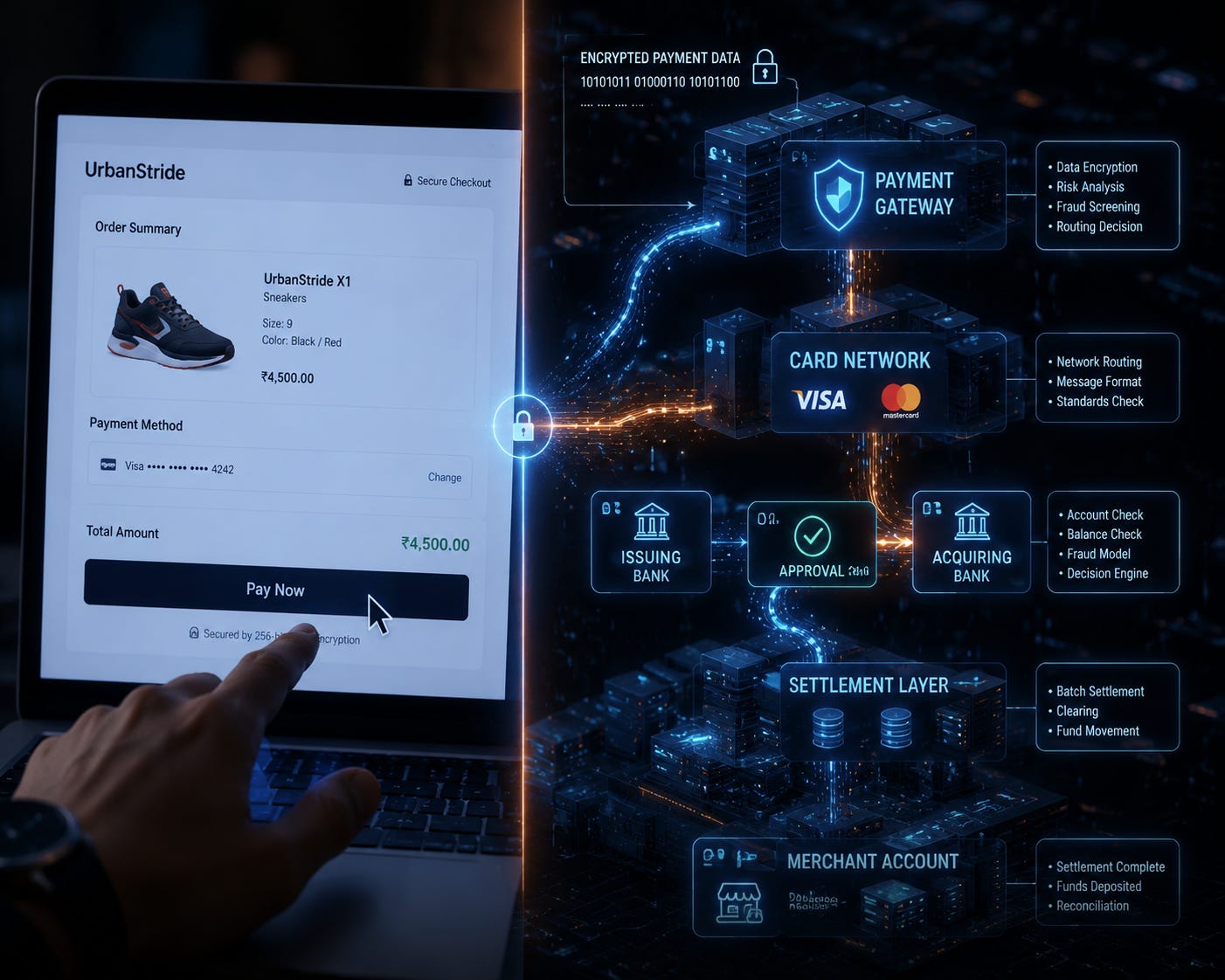
It’s a Saturday afternoon in Pune. A customer taps “Pay Now” on a ₹4,500 sneaker purchase. Within 1.2 seconds, a green success screen appears. The moment feels trivial.
It isn’t.
In that brief window, encrypted payment data travels from merchant to gateway, through card networks, to an issuing bank. The bank runs fraud checks, verifies funds, and sends back a single word: approve or decline. That response ripples back through the system in reverse.
Every step in that chain can fail silently. And when it does, no error appears. No alert fires. Only revenue disappears.
This is the payment gateway. Most people use it every day. Very few understand it.
Context & Problem
India’s digital commerce growth is no longer incremental it’s structural. Digital payments grew 34.8% year-on-year in FY25, and UPI now accounts for roughly 84% of retail transaction volume, according to the National Payments Corporation of India.
But volume hides fragility.
The payment gateway sits between checkout and cash realisation. When it works, it disappears. When it doesn’t, the damage is invisible: failed approvals, broken webhooks, lost conversions, and reconciliation gaps that surface days later.
Most merchants optimise for the wrong variable: onboarding speed or headline MDR instead of system-level performance: approval rates, routing quality, and settlement behaviour.
That’s like choosing logistics partners based only on shipping cost, not delivery reliability.
System Breakdown
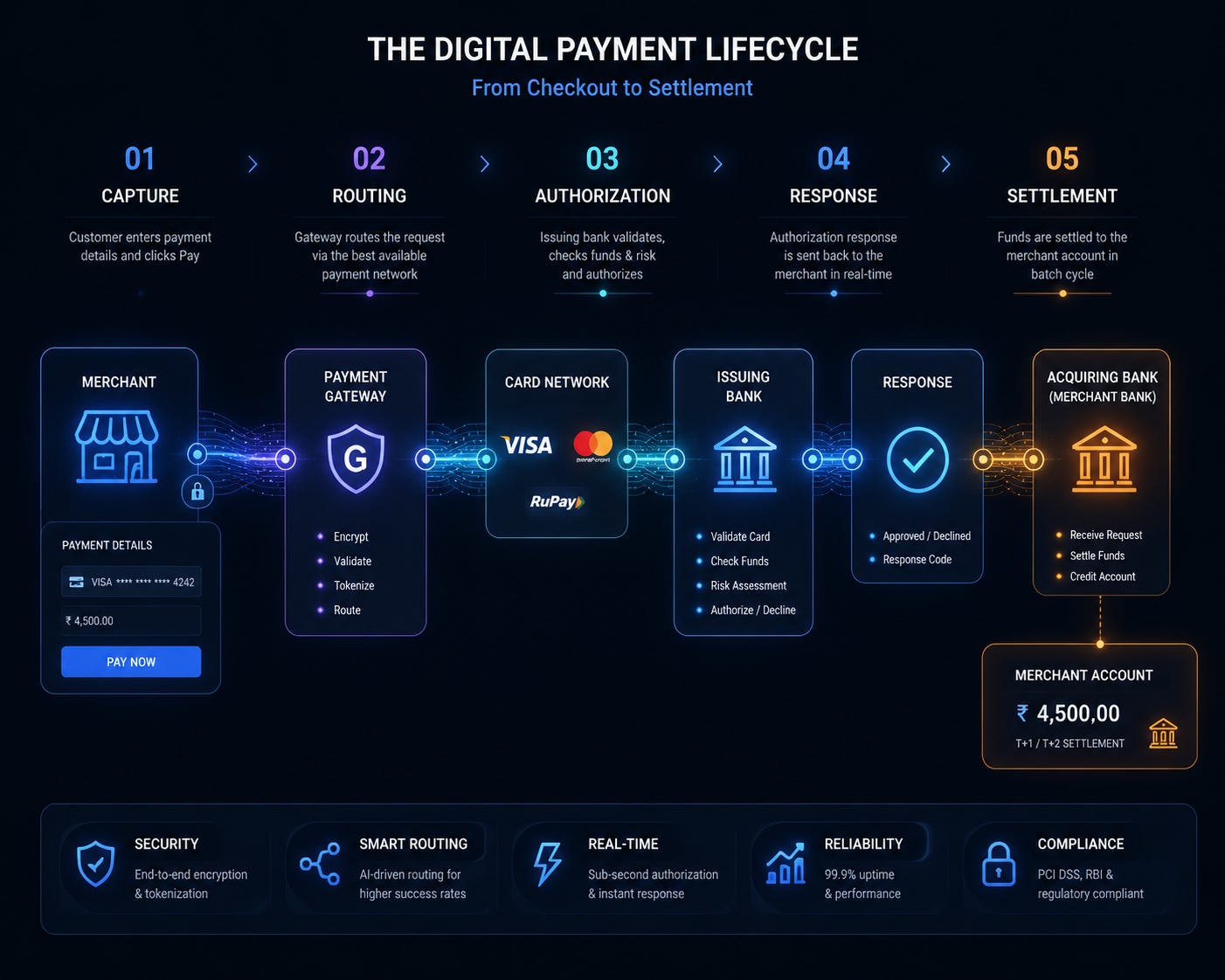
Here’s what actually happens when someone pays online:
Step 1 — Capture
Payment details are entered and immediately encrypted. Sensitive data should never persist in raw form on merchant systems.
Step 2 — Routing
The gateway sends encrypted data to the relevant rail — cards, UPI, or wallets. Card transactions may pass through networks like Visa before reaching issuing banks.
Step 3 — Authorization
The issuing bank evaluates three things in parallel: identity validity, available funds, and fraud risk. The response is binary: approve or decline.
Step 4 — Response
The gateway relays the decision back to the merchant in real time, triggering success or failure states in the checkout flow.
Step 5 — Settlement (later)
Approved does not mean paid. Funds move later in batches. Authorization is a promise; settlement is the actual transfer.
That gap — between approval and settlement — is where most financial blind spots emerge.
Deep Dive
The Pricing Trap
Merchant Discount Rate (MDR) is usually the only number merchants compare. It’s also the least informative.
Typical ranges:
Domestic cards: ~1.5%–2.2%
UPI: often 0%–0.25%
International cards: ~2.9%–3.5% + FX spreads
But MDR is only the starting point.
Add GST, refund fees, FX conversion spreads, chargeback penalties, and rolling reserves and the effective cost can be 1.5–2× the headline rate.
A “cheap” gateway can easily become the most expensive one once friction costs are included.
The Approval Rate Problem
Approval rate is the metric most merchants never track and it is often the most important.
A payment that fails due to poor routing or suboptimal network selection is indistinguishable from fraud in most dashboards. But economically, it’s a lost sale.
Even a 1–2% drop in approval rate can erase a meaningful portion of net margin at scale.
This is why modern stacks increasingly rely on payment orchestration, splitting traffic across gateways like Razor pay, Cash free Payments, and Stripe, dynamically routing based on performance, not static contracts.
The Settlement Cycle Gap
Most gateways operate on T+1 or T+2 settlement cycles. That delay creates a hidden working capital buffer or constraint.
For a business doing ₹10 lakh daily GMV, even a two-day lag means ₹20 lakh is perpetually in transit.
For capital-constrained businesses, gateway selection becomes a liquidity decision disguised as a payments decision.
Webhooks and Invisible Failures
Every successful or failed transaction triggers a webhook a signal sent back to the merchant system.
If that webhook is delayed, dropped, or misprocessed, systems drift out of sync:
Orders appear unpaid when they are paid
Refunds are issued incorrectly
Support teams manually reconcile transactions
These failures rarely show up in SLA dashboards. But they quietly accumulate operational debt.
Key Metrics
Metric Value Context Digital transaction growth (FY25)+34.8% YoY Across all digital rails UPI volume 185.9 B transactions Massive scale, low average ticket UPI share of retail volume~84%Dominant payments rail Chargeback rate (Q3 2025)0.26%Rising rapidly Card MDR (India)1.5%–2.2%Variable by category International MDR2.9%–3.5%+Excludes FX spreads
The structural insight: UPI dominates volume, but not value. That divergence shapes everything from gateway economics to merchant profitability.
Risks
Operational Risk
Gateways are single points of failure. Outages during peak events translate directly into lost revenue.
Even latency matters. A few hundred milliseconds added at checkout can measurably reduce conversion rates.
Financial Risk
Three underappreciated exposures:
Rolling reserves: Working capital locked for months
Chargebacks: Fees + lost revenue per dispute
Fee stacking: Effective MDR far higher than advertised
Security & Compliance Risk
Gateways sit at the intersection of financial data and adversarial behavior.
PCI DSS compliance is necessary but insufficient. Fraud patterns evolve faster than baseline compliance standards.
Bull vs. Bear Case
Bull Case
India’s digital economy is still early in its monetization curve. As subscriptions, SaaS, and cross-border commerce scale, gateways evolve from pipes into optimization engines.
The real moat shifts to:
Approval rate optimization
Fraud intelligence
Multi-rail orchestration
Embedded analytics
In this world, switching costs increase not because of contracts, but because of system dependence.
Bear Case
UPI’s near-zero MDR compresses unit economics at scale.
Meanwhile, gateway functionality is commoditizing. As infrastructure standardizes, differentiation becomes harder to sustain.
Fraud pressure is also rising faster than mitigation systems in certain categories, increasing systemic risk.
Scenario Analysis
Scenario 1 — MDR-first selection
A merchant chooses the cheapest gateway. Six months later, they discover hidden routing inefficiencies causing silent declines. Revenue leakage goes unnoticed for months.
Scenario 2 — Over-optimizing for UPI
Cost reduction improves, but average order value declines due to behavioral anchoring toward low-ticket payments.
Scenario 3 — Cross-border surprise
A SaaS company expands internationally without reviewing FX and MDR structure. Effective fees exceed 7% per transaction.
Scenario 4 — Orchestration advantage
A platform routes dynamically across gateways. Approval rates improve by 4%. At scale, this translates into meaningful recovered revenue.
What Most People Miss
The gateway is not the checkout — it is the decision engine behind it.
“Approved” is not “paid.” Settlement is where money actually moves.
Volume growth can mask value stagnation.
Fraud metrics lag reality.
Switching costs are operational, not contractual.
Key Variables to Watch
Approval rates by bank and method
Settlement timing and working capital impact
Chargeback trends by category
UPI pricing policy evolution
Cross-border payment expansion
Regulatory changes from the National Payments Corporation of India and RBI
Strategic Impact
Payment gateways are not vendors. They are core infrastructure.
For merchants, they influence revenue, conversion, liquidity, and fraud exposure simultaneously.
For investors, the signal is not transaction volume it’s reliability, intelligence, and embeddedness.
For founders, payment architecture decisions compound. Early choices persist longer than most product decisions.
Conclusion
Most digital businesses still treat payments as a utility bill.
But the payment gateway is not a cost centre. It is a conversion system, a liquidity engine, and a risk filter all operating in under two seconds.
India’s digital payment scale is already massive. The next phase of advantage will not come from more transactions, but from fewer failures.
The invisible engine is not invisible when it breaks. It just becomes expensive.
And by then, it’s usually too late to ignore it.
Personal Note
What stands out about payment infrastructure is how much responsibility is compressed into a moment no one notices.
That 1–2 second checkout experience feels like a UI interaction. In reality, it’s a chain of banking systems, risk engines, and routing logic negotiating in real time — and then quietly disappearing again.
Most businesses don’t think about payments until something breaks: a dip in approval rates, a spike in chargebacks, or a reconciliation mismatch that doesn’t add up. By then, the system has already been influencing revenue for weeks or months.
In India especially, where UPI scale has grown faster than most infrastructure layers were designed for, the gap between “payments as a utility” and “payments as a performance system” is widening. The businesses that eventually internalize that difference tend to stop optimizing for cost per transaction — and start optimizing for revenue recovery, liquidity, and reliability.
That shift is subtle, but it compounds.
